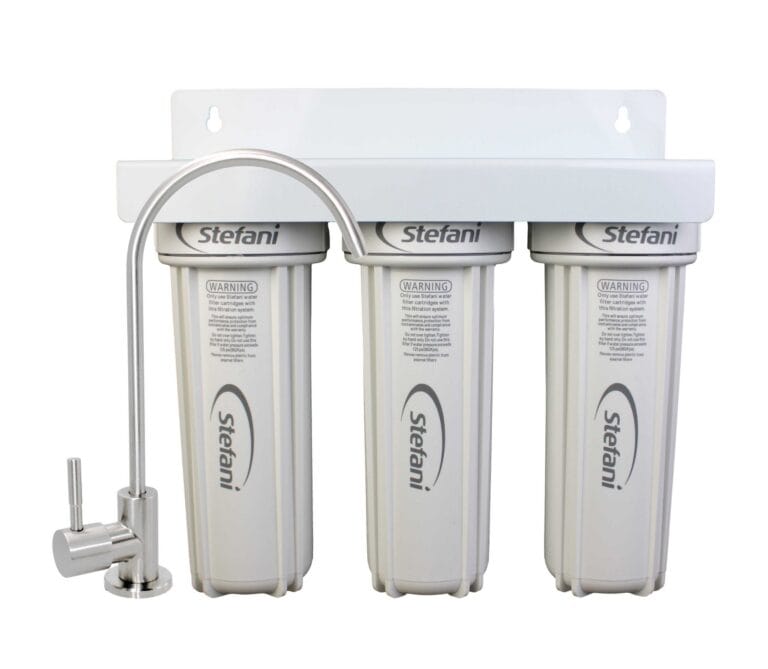
An under-sink filter treats one outlet — almost always the kitchen tap — and treats it thoroughly. A whole-home system filters the water on the main line, so every outlet connected after it gets filtered water, but more coarsely. For most Sydney households, under-sink is the place to start: the usual complaint is the taste of the drinking water, and that’s the cheapest, most direct fix. Whole-home earns its keep when you want chlorine and sediment out of the shower, the washing machine and the rest of the house too.
On price they sit further apart than most people expect. Under-sink and reverse osmosis installation costs $200, plus your chosen system, or $230 for installation of a system you supply. Whole-home installation at the mains starts at $480, plus your chosen system — the same flat-price approach we use for everything, no call-out fee, no hourly rate. Which one deserves your money depends on what you’re trying to fix, and that starts with being honest about Sydney’s water.
Sydney tap water is better than the filter industry admits
Sydney Water treats and tests its supply against the Australian Drinking Water Guidelines, and explains how it keeps that water safe to drink. Anyone selling you a filter on fear is selling the wrong thing.
The honest case for filtering rests on three smaller problems. Chlorine keeps the network safe all the way to your street, but you can taste and smell it, especially in summer. Sediment gets stirred up whenever the mains are worked on, and ends up in your aerators and your kettle. And the water’s last stretch runs through your own pipes — in older Sydney houses, tired copper or galvanised steel, and brass fittings made to older standards. That’s the part Sydney Water doesn’t control, and it can leave the water tasting of the pipes it travelled through. Scale barely rates here — Sydney’s water is soft next to Adelaide’s or Perth’s — so don’t buy a system to fix a problem we don’t have.
Name the problem before you pick a system
Before you spend a dollar, pin down the complaint. Each one points at a different system:
- Chlorine taste or smell in your drinking water. The usual complaint, and the cheapest fix: a carbon cartridge under the sink.
- Something carbon won’t touch. Fluoride or dissolved solids call for reverse osmosis, chosen on what the model is stated to reduce.
- Chlorine in the shower, grit in the aerators. A house-wide complaint needs a whole-home system on the main line.
- A sudden change in colour, taste or smell. That isn’t a filter question. Check Sydney Water’s fault advice first. If only one tap is affected, the cause is more likely in your own plumbing, and a licensed plumber should look at it.
Under-sink filters: single-stage or reverse osmosis
A single-stage under-sink unit is the workhorse. A carbon-block cartridge tees into the cold line under the kitchen sink and feeds its own small tap beside the mixer. Carbon strips chlorine on contact, and a good block is dense enough to double as a fine sediment filter — down to around a micron — so one cartridge answers both complaints that push most people towards filtering. Our under-sink range has carbon systems like this alongside reverse osmosis. Cartridges are cheap, the unit disappears once the cupboard door shuts, and flow at the filtered tap is close to normal.
Our installation gives the tee its own isolation valve, so the filter can be shut off without cutting water to the kitchen. It mounts the head where a cartridge can be swapped without emptying the cupboard, and fits the dedicated tap through a spare hole in the sink, or a new hole we drill in stainless steel or laminate. Stone and other surfaces need checking with us before you book.
Reverse osmosis is a different animal. Water is forced through a membrane fine enough to reject dissolved solids, so RO goes further than carbon: it reduces fluoride, most of the dissolved solids the water is carrying, and heavy metals picked up from old pipework. Each model lists what it is designed to reduce, and that’s the list to check. The membrane works slowly, so most systems store filtered water in a small pressurised tank and the dedicated tap runs gently rather than gushing. A portion of the incoming water carries the rejected solids to the drain — that’s how the membrane keeps itself clean — typically a few litres per filtered litre on older designs, less on newer ones. And because RO strips minerals along with everything else, many systems finish with a remineralising cartridge to put some taste back. Our reverse osmosis buying guide compares the systems in our range.
The rule between them: for chlorine taste and smell, a carbon system fixes it for less money and less cupboard space. RO is for what carbon can’t reach, such as fluoride and dissolved solids, and for anyone who doesn’t trust their internal plumbing.
Before you order a unit from anywhere, know that connecting a filter into the water supply is licensed plumbing work in NSW — the same line NSW Fair Trading draws around tap work. Changing a cartridge is ordinary maintenance, fair game for anyone; the tee into the cold line and the new tap through the sink top belong with a licensed plumber.
What a whole-home system does — and what it can’t
A whole-home system mounts where the water enters the property, usually near the meter, so every tap, shower and appliance downstream gets the benefit; a garden tap that branches off before that point won’t. The cartridges are large-bodied versions of the same idea — sediment first, then carbon — and sizing is the point: the whole house draws through them, so an undersized filter announces itself as a weak shower the moment someone opens a second tap. Part of our whole-home install is checking your incoming pressure and fitting isolation valves either side of the housing plus a bypass, so a cartridge change takes minutes and the house keeps its water while it happens. If you have the choice of spot, keep the housing out of direct sun: polypropylene bowls go brittle after years of UV.
The change is most obvious in the shower, where a carbon stage takes the chlorine smell out. The quieter benefit: grit slowly kills the ceramic cartridges inside modern mixers — one of the usual reasons a mixer starts dripping — and the small solenoid valves inside washing machines and dishwashers. Catching it at the meter helps protect all of them at once.
The limits matter, though. A whole-home system is a coarse filter running at high flow. It won’t remove fluoride or dissolved solids the way reverse osmosis does, so it’s no substitute for a drinking-water system. And because it sits at the boundary, it can’t undo anything your own pipework adds after it. A 1960s house with original galvanised pipe will still leave its signature between the meter and the kitchen tap. The two aren’t really rivals. A common setup is whole-home for the showers and appliances, with an under-sink unit polishing the drinking water — each doing the job the other can’t.
The maintenance you’re signing up for
Every filter is a consumable, and the biggest mistake owners make is treating installation day as the end of the story. A spent carbon cartridge stops removing chlorine and slows your flow — you get the ritual of filtered water without the result. Your system’s manual sets the real intervals; as a rough guide:
- Single-stage under-sink: a new cartridge every six to twelve months. A clogging block slows the tap; exhausted carbon lets the chlorine taste creep back; either means it’s due.
- Reverse osmosis: pre- and post-filters roughly yearly, the membrane every two to three years. Changing pre-filters on time is what protects the expensive membrane behind them.
- Whole-home: driven by sediment load more than the calendar. Check the sediment cartridge after any mains work in your street, and expect a change or two a year.
A new carbon cartridge sheds fine black dust on first fill — run the tap for as long as the manual says; that’s carbon fines, not a fault. Swaps themselves are the genuinely DIY part of filter ownership, the same minor-maintenance basket as a tap washer: shut the isolating valve, open the filtered tap to let the pressure off, and undo the housing with the spanner it came with, or twist out a quick-change cartridge. If you’ve lost track of which cartridge a system we supplied takes, ask through the customer help page and we’ll point you at the right one.
Which one to buy
Match the system to the complaint. Chlorine taste or smell in the drinking water: a carbon under-sink system; installation costs $200, plus the selected system, with replacement cartridges to budget for. Fluoride, dissolved solids or old pipework you don’t trust: reverse osmosis at the point of use, at the same installation price, accepting the slower tap and the tank in the cupboard. A house-wide complaint — chlorine in the shower, grit in the aerators, appliances worth protecting — whole-home installation from $480, plus the selected system, with under-sink added later if the drinking water deserves its own polish.
Every system in our water filters and reverse osmosis range is priced the TapLife way: the figure on the page covers the unit, the delivery and the licensed install (NSW licence 498555C). A system in stock gets its install day and arrival window at checkout; a made-to-order system is booked once it arrives, and the product page says which. We install under-sink systems seven days a week and whole-home systems every day except Fridays, across our Sydney metro service area. The installation is backed by our 12-month workmanship warranty, and your Australian Consumer Law rights sit on top. If you bought the system from us, come to us about any fault: working out whether it’s the product or our installation is our job, not yours. If you’ve already bought a unit elsewhere, we’ll fit it: under-sink installation is $230 for a system you supply, whole-home installation costs the same as for a system we supply, and the unit’s own warranty stays with its seller or manufacturer.