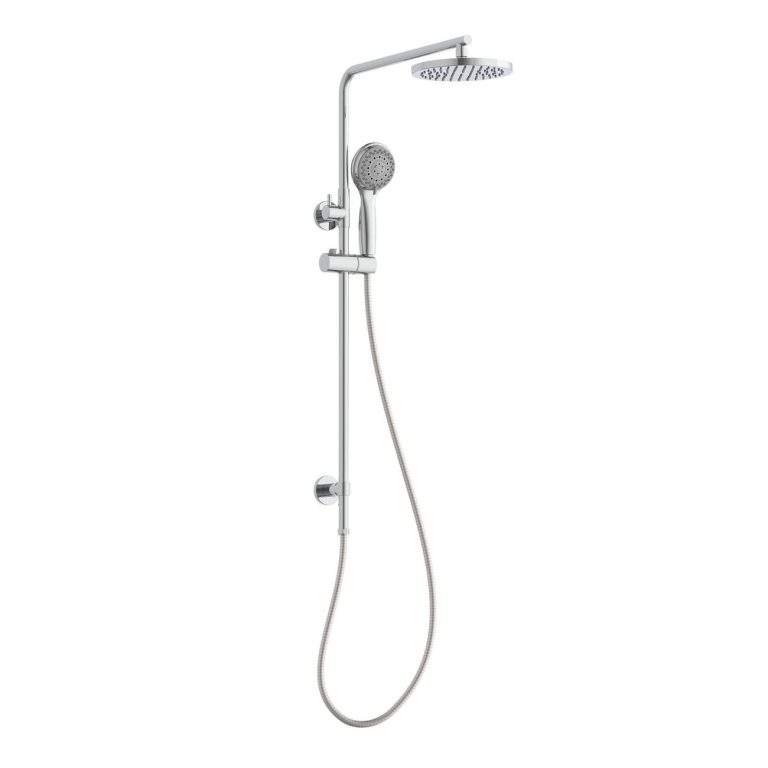
A rain shower is a wide, flat head — usually 200 to 300 millimetres across — mounted overhead so water falls straight down on you. A rail shower is a handset on a flexible hose, clipped to a vertical bar so it slides to any height you want. Which to buy turns on something people rarely check before ordering: the water pressure at your shower outlet.
The short version: good mains pressure and a taste for standing under the water rather than aiming it, buy the rain head. Ordinary or unknown pressure, a shared bathroom, kids, a dog that needs washing — buy the rail. And if you’re genuinely torn, a twin combination puts both on one set of plumbing. That’s where we’d steer most Sydney households.
What each one actually is
A rain head is fixed. It mounts on a wall arm reaching out from your existing shower outlet, or on a drop arm from the ceiling, and the wide face breaks the flow into dozens of gentle streams meant to mimic — the name gives it away — rain. You stand under it. You don’t aim it. If you go the wall-arm route, check the arm’s projection before you buy: a short arm hangs the water tight against the tiles, and you end up showering pressed to the wall. About 400 millimetres of reach is the comfortable minimum under a full-size head.
A rail shower is the opposite philosophy. The handset lifts off its bracket, the bracket slides up and down the rail, and the hose gives you a metre and a half of reach. Rinsing shampoo out of a toddler’s hair, hosing down the shower screen, showering on a stool after a knee operation — the rail does all of it. If you also need a rail to hold on to, see our grab rail installation cost guide.
Sydney water pressure decides more than the brochure does
Most Sydney homes on mains-pressure hot water have enough push to run either style well. The exceptions matter. Older houses with a gravity-fed storage tank in the roof deliver hot water at a fraction of mains pressure, and some apartments — upper floors of older blocks especially — run noticeably soft. Newer builds usually have a pressure-limiting valve at the meter, typically set around 500 kPa. That’s kind to your flexi hoses and appliances, and still plenty for a modern nine-litre head — the genuine strugglers are the tank in the roof and the top-floor flat.
A big rain head is the fixture low pressure punishes hardest. The flow has to spread across the whole face, and when there isn’t enough of it, water dribbles from the centre ring while the outer nozzles barely weep. The 300-millimetre head that looked spectacular in the showroom becomes a lukewarm drizzle you chase around under.
A handset hides the same weakness. Its face is small, so the same litres per minute come out concentrated and quick. On a struggling gravity-fed system, a good rail handset feels like twice the shower a big rain head gives — off identical pipework.
Continuous-flow gas hot water adds a quirk of its own. The unit needs a minimum flow through it before the burner fires, and a very efficient head with the mixer blended well towards cold can drop the hot-side draw near that threshold. The tell is a shower that hunts — hot, briefly cold, hot again — as the burner cuts out and relights. If that’s your current shower, mention it before choosing a head, because an even lower-flow model can make it worse.
If you’re not sure what you’ve got, run the bucket test. Put a bucket under the current shower running flat out — lever fully open, or both taps on a two-handle set — and time it. A 9-litre bucket filled in about a minute means you’re getting the full flow a modern head is rated for, and on mains pressure a rain head should behave. Slower than that, don’t blame the plumbing yet: unscrew the head from its arm — the one bit of the shower you’re allowed to remove yourself — and time the open outlet. Fills well under a minute now, and the supply is fine; the old head was the bottleneck. Still slow, and the supply itself is the limit, usually the pressure. Shop for a rail. A bucket measures flow rather than pressure, so if you’re on a gravity-fed tank or the result is borderline, a plumber’s pressure gauge on the outlet settles it.
What a 3-star WELS rating means for shower feel
Nearly every shower head sold in Australia carries a WELS water-efficiency label, and the common rating is 3 stars — nine litres a minute at most, where old pre-regulation heads could pass far more. The cap applies equally to a basic handset and a premium rain head, which surprises people. The huge head doesn’t deliver more water. It spreads the same water wider.
This is where brand engineering earns its money. Methven, Caroma and Phoenix put real work into droplet size and spray pattern so nine litres feels like more — Methven’s Satinjet, for one, collides paired jets to break the stream into heavier, slower droplets. That’s why two heads with identical star ratings can feel completely different, and it points to a spending rule: if the budget forces a choice, pay for the spray engineering, not the diameter. A well-designed 250-millimetre head usually beats a cheap 300.
The twin shower, if you can’t pick a side
A twin shower — rain head up top, handset on a rail below, a diverter to switch between them — is the both-ways answer. One set of plumbing feeds both outlets, so in most bathrooms it fits the existing shower connection without new pipework.
For example, the Estilo 3 Function 1/2 twin rail shower set is $293 supplied and installed.
Two honest caveats. The diverter is one more moving part, and most run one outlet at a time rather than both together — fine, since splitting nine litres two ways pleases nobody. And the combined unit puts more hardware on the wall, so it suits a full-height tiled wall better than a small fibreglass cubicle.
Wall arm or ceiling mount decides the size of the job
A wall-arm rain head, a rail or a twin combo all connect to the shower outlet you already have. Swapping one for another is straightforward licensed work — our installation-only shower service costs $180, the same figure whether the job takes twenty minutes or two hours. On the day it runs to a set sequence: water isolated, old unit off, the outlet thread behind the wall checked and resealed, new unit on, then a leak test at full pressure before the plumber leaves.
In NSW, the one piece you can genuinely do yourself is unscrewing an old head from an existing arm and screwing on the new one — the same line we map out for taps. Anything more, from connecting a new unit to the water supply to running pipework behind the wall, is licensed plumbing work. NSW Fair Trading’s guidance covers where the line sits.
A ceiling-mounted rain head is another job entirely. The water has to get up into the ceiling cavity — new pipework, holes in plasterboard or tiles, re-waterproofing. That’s a renovation, not a shower swap. If you love the ceiling look but the bathroom isn’t being gutted, a long wall arm mounted high gets you most of the way there for a fraction of the disruption.
Heights, tiles and keeping the nozzles clear
Mounting height deserves a minute’s thought. A rain head wants clearance well above the tallest person in the house — around 2.1 metres is typical — so check your ceiling and any bulkheads first. A rail sidesteps the argument: everyone sets their own height. That’s why it wins in shared bathrooms.
If you’re replacing an existing rail, expect the new rail’s screw holes to miss the old ones. That leaves holes in the tile — a bead of colour-matched silicone usually tidies them — and it’s worth knowing before the old unit comes off the wall.
Maintenance is the quiet advantage of modern heads either way. Nearly all now use flexible silicone nozzles: a rub with your thumb while the water runs cracks mineral build-up straight off. A handset can also come off and sit in a bowl of warm vinegar; a fixed ceiling head can’t — one more small argument for the rail wherever scale keeps showing up on your glass and chrome.
Five checks before you order
Run these in order and the decision mostly makes itself.
- Bucket-test the current shower, flat out. A 9-litre bucket filled in about a minute is the flow modern heads are rated for; slower than that, repeat with the head unscrewed — still slow rules out the big rain faces.
- Identify the hot water system. A storage tank in the roof means gravity feed — rail territory. Continuous-flow gas means watching the minimum-flow quirk above.
- Measure the ceiling over the shower. Much under 2.3 metres and a rain head crowds the tallest user; a rail doesn’t care.
- Be honest about wall versus ceiling. See the shower installation cost guide for its current $180 price and eligible work; ceiling changes need a separate assessment.
- Count the users. One or two adults with settled preferences can commit to a fixed head. Kids, guests, older knees or a dog make the case for a handset — on its own rail, or under a rain head in a twin.
Every shower on our site is listed at one price with delivery and licensed installation already in it — no call-out fee and no hourly rate. Any additional work is priced and agreed before it starts. Look through the rails, rain heads and twin combos in our showers range, and if you’ve already bought a shower you love, our BYO shower installation service fits it at the same rate.